How to fluff an artificial christmas tree
How to Fluff an Artificial Christmas Tree, Section by Section
The essentials
Fluffing is the hand shaping that opens a folded tree: one section at a time from the bottom, each branch from the pole out to its tip. Makers allow 45 to 60 minutes for a 7.5 ft tree and up to 1.5 hours at 9 ft, and no light or ornament makes up for a skipped branch.
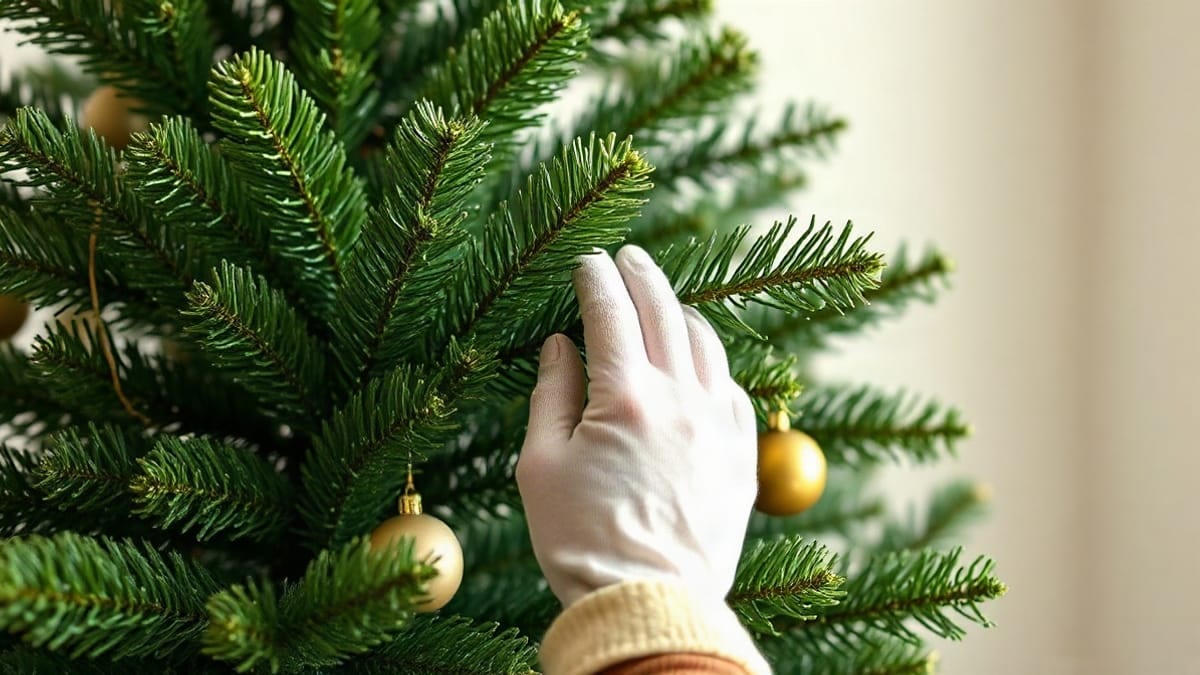
A tree that comes out of the box looks like a folded umbrella. Every branch is pressed flat against the pole, and the tips are bent the way the packing left them. The shape you see in the listing photo only appears after you work each branch by hand, and that work is what makes a fake Christmas tree look full instead of tired. In this guide we explain the method we would follow, how long it takes by height, how to fix a branch that sags, and what to do with wires and lights, using what 75 manufacturer listings on Amazon.com say and the public safety sources.
Contents7 sections
- 01What is the best way to fluff an artificial Christmas tree?
- 02How many minutes does a tree take to fluff out, by height?
- 03How do you put together and set up an artificial Christmas tree?
- 04How do you make a sparse artificial Christmas tree look fuller?
- 05What does it take to refresh an old artificial Christmas tree?
- 06Questions about fluffing an artificial Christmas tree
- 07Sources
What is the best way to fluff an artificial Christmas tree?
The essentials
Work one section at a time, from the bottom section to the top one. On each branch, start next to the pole and move out to the tip. Pull every tip apart, point the outer ones up and out, and leave no tip lying flat.
Knowing how to fluff an artificial Christmas tree means knowing one job: fluffing is the hand shaping that turns a stack of folded branches into a round tree. The tips are wire-cored, so they bend and stay where you put them. Nothing else makes the tree look as full as it can, and no light or ornament hides a branch that was never opened.
Two listings give the order in words. Balsam Hill writes that the tree ships compressed, "requiring proper tree branch shaping section-by-section from bottom to top". National Tree Company writes that you shape the tree "by peeling back the branches and pulling the tips apart". Those two lines are the whole method in a sentence each, and the steps below add the detail.
| Step | What you do | What to check before moving on |
|---|---|---|
| 1. Drop the branches | On a hinged section, let every branch fall to its working position. Lift any branch that is caught under another | No branch hangs against the pole |
| 2. Open the inner tips | Start at the pole. Pull each fork of tips apart so the needles point in different directions | You can see between the tips, not only the top of them |
| 3. Move to the outer tips | Work toward the end of the branch and point the last tips up and out | The branch ends in a fan, not a bundle |
| 4. Step back | Look at the section from 6 ft away and turn the tree | The outline is round, with no visible window |
| 5. Do the next section up | Repeat on the section above, then fit the top | The section you left stays open as you work above it |
Why work from the bottom to the top, and from the pole to the tip?
The base is the widest part and carries the most tips, so a finished base sets the width the rest of the tree has to match. Working up also means you never lean across a section you have just finished.
Inside to outside has the same logic on a single branch. If you fan the tip first and then reach for the inner tips, your arm crushes it. We have not set up a tree for this guide, so this is our reasoning from the listings and not a measurement. One listing, the HC-PVC tree sold by GarveeLife, writes the same direction: "Spread and shape the tips from the inside outward".
How do you fluff a new fake Christmas tree out of the box?
Fit the stand and the pole sections first, then fluff one section at a time as you stack it. That is what the Best Choice Products listings describe: stack each section from the largest to the smallest, "then fluff and enjoy". Shaping a section while it is low and easy to reach saves climbing a step stool for the top section later.
A tree that ships compressed has tips pressed in one direction. Open them in three passes. Pull the tips of each fork apart, bend the outer ones up, then turn the whole branch a little so the needles do not all face the front.
How do you shape one branch?
Hold the branch near the pole with one hand. With the other, take each fork of tips and spread it like a hand. Then move one step out along the branch and repeat. The goal is tips that point in many directions, with the longest tips at the end of the branch and the shorter ones nearer the pole.
Leave the lower inner tips pointing slightly down. They hide the pole, and a fully raised inner tip leaves a gap between the branch and the trunk.
Do you need gloves?
Yes, a light pair is worth having. Six of the 75 listings include gloves in the box, among them Balsam Hill, which lists "protective gloves for safe tree branch shaping", and the Casafield 9 ft spruce. The wire at the core of a tip can scratch a bare hand after an hour of bending, and a glove also keeps oils and fiber off flocking. Garden gloves work if the tree came without.
How do you fluff a pre-lit tree without pulling on the wires?
Bend the branch, never the wire. On a pre-lit tree the light string follows each branch, and a tug on a bulb can loosen a socket or strip the insulation. Hold the branch by its main stem with one hand and shape the tip with the other, and keep every plug seated in its receptacle as you work.
Fluff before you plug in, then check that every section lights up. The U.S. Fire Administration tells owners to "throw away light strands with frayed or pinched wires", and the National Fire Protection Association (NFPA) says electrical distribution or lighting equipment was involved in two in five (40 percent) home Christmas tree fires between 2020 and 2024. A pinched wire is the kind of fault that shaping can cause, so look for it instead of waiting for it.
Good to know
Never pull a bulb or a cord to straighten a branch. If a section no longer lights after you shape it, unplug the tree and check the plug between sections before you shape anything else.
How do you fluff a flocked tree?
Gently, and with dry hands. Flocking is a coat on the surface of the tip, and a hard squeeze can flake it. Spread the tips with two fingers and avoid pinching the white coat. A flocked tree sheds a little whatever you do, and our flocked trees page covers how to decorate one and which of the ten we ranked holds its coat best.
How many minutes does a tree take to fluff out, by height?
The essentials
Plan on 15 to 30 minutes for a 4.5 ft tree and 1 to 1.5 hours for a 9 ft tree, going by the Best Choice Products listings. A tree does not fluff itself. The time is your hand time.
Before you plan an evening, know that the question has two readings. One is how long the work takes, and the other is whether a tree opens up over days on its own. For the second, none of the 75 listings says branches spread by themselves, and the Balsam Hill wording points the other way: the tree ships compressed and needs shaping by hand. For the first, only a few listings give a figure, and they do not agree with each other.
| Listing | Tips written | Time written | Tips per minute implied |
|---|---|---|---|
| HOMCOM 6 ft pencil | 390 | about 30 minutes | 13 |
| National Tree Company 7 ft Kingswood Fir Slim | 892 | 45 to 60 minutes | 15 to 20 |
| National Tree Company 6 ft Dunhill Fir | 1,430 | 45 to 60 minutes | 24 to 32 |
| Casafield 9 ft spruce | 2,000 | 45 to 60 minutes | 33 to 44 |
| National Tree Company 7.5 ft Dunhill Fir | 2,514 | 45 to 60 minutes | 42 to 56 |
| Best Choice Products 9 ft Slim Aspen | 3,088 | 1 to 1.5 hours | 34 to 51 |
| Best Choice Products 9 ft Aspen | 3,880 | 1 to 1.5 hours | 43 to 65 |
| National Tree Company 9 ft Dunhill Fir | 4,026 | 45 to 60 minutes | 67 to 89 |
The last column is our arithmetic: tips divided by minutes. It shows that the makers' times follow a stock line, not the tree. National Tree Company writes 45 to 60 minutes on a tree of 892 tips and on one of 4,026, which would mean 15 tips a minute on one and 89 on the other. Treat a time on a listing as a floor for a trained hand and not as a promise.
How long will your tree take, by tip count?
We pose a pace of 40 tips a minute for a first fluff by one person wearing gloves. That is a choice, not a measurement, and it sits in the middle of the 13 to 89 range the listings imply. A slower hand at 25 tips a minute and a quick one at 60 give the outer limits.
| Tips on the tree | At 25 a minute | At 40 a minute | At 60 a minute |
|---|---|---|---|
| 1,086 (a 7.5 ft pencil tree) | 43 minutes | 27 minutes | 18 minutes |
| 1,446 (a 7.5 ft tree) | 58 minutes | 36 minutes | 24 minutes |
| 2,028 (a 9 ft tree) | 81 minutes | 51 minutes | 34 minutes |
| 2,514 (a 7.5 ft pre-lit tree) | 101 minutes | 63 minutes | 42 minutes |
| 3,880 (a 9 ft full tree) | 155 minutes | 97 minutes | 65 minutes |
| 4,026 (a 9 ft full tree) | 161 minutes | 101 minutes | 67 minutes |
Divide your tip count by 40 to get your own number. If a listing does not print the count of tips, look at tips per foot on our guide to the best artificial Christmas trees: a tree near 335 tips per foot has about twice the work of one near 160.
Tip count is why a 9 ft slim tree with 1,443 tips takes less time than a 7.5 ft full one with 2,514. Height tells you how long the pole sections are. The count of tips tells you how many forks your hands must open.
How do you put together and set up an artificial Christmas tree?
The essentials
Clear a floor circle, assemble the stand, stack the sections from the largest to the smallest, fit the top, and fluff each section as you go. Plug in last.
Start with the room, not the box, because how to fluff an artificial Christmas tree matters less than whether it fits. Measure the ceiling and the floor circle, subtract a few inches for the stand and 6 to 12 inches for a topper, and compare the result with the tree's written height and base width. Our size calculator does the arithmetic, and it is the answer to how to measure a tree against a room.
- Open the box on the floor where the tree will stand, so you do not carry the heavy bottom section across the room.
- Set the stand on a level floor and tighten its bolts or its legs. A loose stand is the common reason a tree leans.
- Fit the bottom section, then the middle ones, then the top, and match any letter or color code written on the pole.
- Drop the branches and fluff each section before you add the next, as in the method above.
- On a pre-lit tree, connect the section plugs, then plug in at the base and check every section.
What does the manual not tell you about setting up a tree?
Three things. A section stacked wrongly means light cords that do not reach, so match the labels before you push a section down. A top section forced onto its pole can bend the pole, so seat it by hand. And a stand that sits on carpet needs a flat base under it, or the tree settles and leans by December.
Hinged branches or hooks: which is quicker to put up?
Hinged branches are quicker, and they are now the usual design: 51 of the 75 listings write the word hinge. A hinged branch is attached to the pole and drops down as you stack the section, so there is nothing to sort. Our glossary of hinged trees explains how the hinge works. A tree whose branches are inserted by hand takes longer, because each branch has to be matched to a numbered slot before you can shape it.
How do you fix sagging, bent or broken branches on an artificial Christmas tree?
Identify the cause first. A branch that droops on a hinged tree is usually not locked in its working position. A branch that bends down at a tip has often been stored under pressure. A branch with a snapped wire is broken, and no shaping will hold it.
| What you see | Likely cause | What to try |
|---|---|---|
| Whole branch hangs against the pole | Hinge not dropped, or the branch is caught under another | Lift the branch and let it fall to the working position |
| Tips point down in a row | Bent in storage | Bend each tip up and out by hand, one at a time |
| A loose branch that spins on the pole | The fixing is not seated in its socket | Push it in until it stops, then check the pole for a loose pin |
| A snapped wire in a tip or fork | Metal fatigue after repeated bending | Fold the broken end in, bend the neighboring tips over it, or fill the gap with a spare branch |
| A pre-lit branch that sags | The light string weighs on the tip | Support it with a neighboring tip, and never tie it by the bulbs |
If a branch is truly broken and the tree is under its written warranty, a replacement part is the better fix. Only nine of the 75 listings write a warranty term, and the longest is 5 years, written by Puleo International and by some National Tree Company trees.
Can you fix a tree that has a dead section of lights?
Not by fluffing. A dark section of a pre-lit tree needs the plug, the fuse and the bulbs checked, which is a different job from shaping. Our pre-lit trees page explains what to look at first and what to do when a section goes out.
How do you make a sparse artificial Christmas tree look fuller?
The essentials
Open the inner tips first, tilt the outer ones up, then move a few branches to cover the gaps. A thin tree usually has tips it has not used, and a second pass often fills more than a new tree would.
A sparse tree has one of two problems. Either the tips are there but folded, or there are too few of them for the height. Fluffing fixes the first. Only a topper, garland or extra branches fix the second.
Check which one you have with a simple count. Divide the tips by the height in feet, which also tells you how to fluff an artificial Christmas tree that looks thin: open it, or add to it. A tree near 335 tips per foot has plenty to open. A tree near 85 tips per foot, like the Best Choice Products 7.5 ft flocked pencil tree, will look thin however you shape it, and the slim trees page shows what that trade costs.
How do you fill the gaps without buying anything?
Rotate the tree a quarter turn so you see the gap from the front. Pull the tips of the nearest branches toward the gap, and bend the tips just above it down to cover. Then step back and look from the main spot in the room, not from the side. A gap that cannot be seen from where people sit is not worth the effort.
If the tree is a hinged one and the gap sits at a join between two sections, loosen the branch above and drop it a little lower, which closes a window between the sections.
Does PE or PVC change how you fluff?
A little. PE tips are molded and hold the shape you give them, so you can set each fork and leave it. PVC tips are cut from film and flexible, so they need a second look after a day, since they tend to relax. Our PE vs PVC guide explains the two plastics. We have no source that measures how fast either relaxes, so this is a rule of thumb and not a result.
Can you flock an artificial tree yourself?
It can be done, but it is a project of its own, and we have not done one. The coat is sprayed or dusted on, and the cost is a tree that is harder to clean and a mess to sweep up. Two cautions come from the sources. The U.S. Consumer Product Safety Commission (CPSC) tells buyers to look for the "Fire Resistant" label when buying an artificial tree, and that label describes the tree as it was sold, not one you coated at home. And a spray should stay off bulbs and cords.
Read the product's warning label before you start. If you only want the snow look, a tree that is flocked at the factory removes the guesswork, and our flocked trees page ranks ten of them.
What does it take to refresh an old artificial Christmas tree?
The essentials
Dust it, open every branch again, which is how to fluff an artificial Christmas tree you already own, replace what is broken, and judge the tree by its tip count and not by its age. A shaped, clean tree can look new for many seasons.
Refreshing a tree takes three steps: clean, reshape, repair. Take the sections apart and lay them on a sheet so you can reach every tip. Then shape each branch as for a new tree, and put the worst branches at the back of the tree, where they show least.
How do you clean an artificial Christmas tree, including a white or flocked one?
Dust is the main problem, and it comes off with a soft brush or a dry cloth on a green tree. For a flocked or white tree, the cloth should be dry and the touch light, since water can lift the coat. For a pre-lit tree, unplug it and keep water away from sockets and plugs. If a stored tree smells musty or shows mold, we found no agency guidance on cleaning it, so read the maker's care sheet before you try anything.
How do you store a tree so it fluffs faster next year?
Fold the branches along the pole with the tips pointing up and not crushed against the box, and keep the sections in their bags or box in a dry place. A tree stored this way opens faster, because the tips are not creased. The National Tree Company listings write that hinged branches "fold back in for quick and convenient storage", and four listings put a storage bag or box in the package.
When is it time to replace the tree instead?
The only figure we can source is a study for the American Christmas Tree Association, the makers' group, which put the break-even point between a real tree and an artificial one at 4.7 years. It says nothing about when a tree stops looking good, and our page on how long an artificial tree lasts goes through what is known and what is not.
Questions about fluffing an artificial Christmas tree
Can fluffing alone make a fake Christmas tree look real?
It makes a large difference, but it is not enough alone. A fully shaped tree with tips in many directions reads as a real tree from across a room. At arm's length the material decides, which our PE vs PVC guide explains.
How often should you fluff the tree during the season?
You do not need to redo the whole tree. A quick pass over the branches that were bumped when you decorated is enough. If you add a heavy ornament and the branch dips, bend the tip up once and move the ornament closer to the pole.
Should you fluff the tree before or after the lights go on?
Before. On an unlit tree, shape each section first, then string the lights from the bottom up. On a pre-lit tree, shape first as well, then plug in and look for dark spots. A pinched wire is far easier to see on an open tree than on a decorated one.
Is there a trick to fluffing a tall tree?
Use a stable step stool for the top section and keep one hand on the pole. Better still, shape the top sections while the tree is only partly assembled, then fit them. A tall tree has the same method as a short one, and only the time differs, as in the tables above.
What do the listings say about fluffing?
Thirty-six of the 75 write the word fluff, and 35 write shape or shaping as a step. Nine give a time or a time range, and the rest say "easy" or "minutes". The only ones that give a method in words are National Tree Company (peel back the branches and pull the tips apart), Balsam Hill (section by section from the bottom up) and GarveeLife (inside to outside).
Is it safe to leave a tree plugged in while you fluff it?
No. Unplug it while you shape the branches. The NFPA tells owners to turn off tree lights before leaving home or going to bed, and the CPSC says never to string together more than three sets of incandescent lights. Check the maker's notice for the number of strands to connect, since the NFPA and the U.S. Fire Administration both ask you to read it.
Where do I find a tree that is easier to fluff?
Look at the tip count, the hinge and the stated fluffing time. Our best artificial Christmas trees page gives tips per foot for each tree, and the best pre-lit trees page covers light strings.
What should you do if the tree has no instructions?
Follow the general order: base, bottom section, middle, top, shaping each section as you go. If sections are not marked, test-fit each one before you push it down, and look at the pole sizes. A wrong section in the wrong slot is easy to see when you try it dry.
Sources
- Amazon.com product pages of 75 artificial Christmas trees, bullet points and technical sheets, read November 14, 2026.
- National Fire Protection Association, Winter holidays, 2020 to 2024 figures, consulted November 14, 2026.
- National Fire Protection Association, Christmas Tree Safety tip sheet, 2025.
- U.S. Fire Administration, Holiday Fire Safety, consulted November 14, 2026.
- Consumer Product Safety Commission, Happy Holidays Start with Safety, November 19, 2024.
- WAP Sustainability for the American Christmas Tree Association, 2018 life-cycle assessment, paid for by an association of artificial tree makers.